nayel rehman / electrical engineer
for rainmaker
satellite remote sensing

evidence for systems that touch the real world

rainmaker needs more than a model. it needs proof.

At Orchard, I built the benchmark that measured model performance across real customer deployments. Rainmaker is building the same kind of truth layer for the atmosphere, and that is exactly the work I want to own.

see the evidence ↓
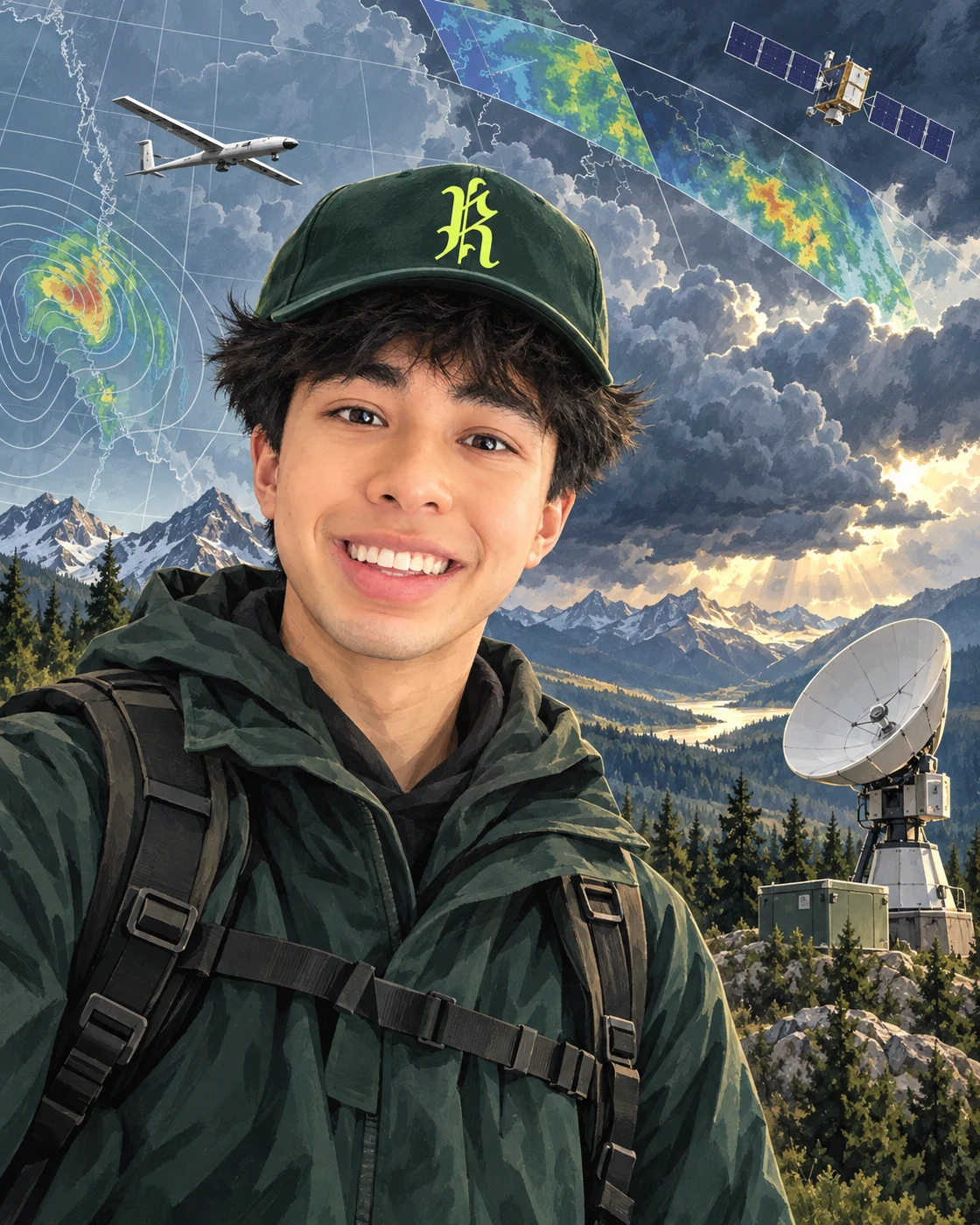
Illustration of Nayel wearing a Rainmaker cap in a satellite weather sensing scene
candidate visual / 01measure what matters
12Mfruit instances in a production dataset
6 PhDsdomain experts hired and managed
7%mAP lift on multispectral perception

01 / orchard benchmark

the closest evidence is already shipped.

Rainmaker asks fellows to establish a baseline, validate it against independent evidence, quantify failure modes, and leave behind a reproducible benchmark. I have already built that loop inside a sensing company.

production evaluation / orchard robotics

a benchmark for the conditions customers actually create.

I built automated validation tooling to compare model performance across customer deployments, then connected the evaluation to a hyper-realistic synthetic orchard dataset with roughly 12 million fruit instances and expert review from six PhD agronomists.

The important part was not one score. It was building a system that could find where performance changed, explain why, and be run again.

01baselineA stable reference before claiming an improvement.
02real variationPerformance compared across customer deployments, not only a clean test set.
03domain truthExpert validation brought the edge cases back to physical reality.
04repeatabilityAutomated tooling turned evaluation into infrastructure instead of a one-off analysis.

02 / why rainmaker

a company willing to measure the hard part.

Rainmaker closes the loop from weather awareness to UAS deployment to satellite and radar validation. The product only becomes credible when the measurement layer is as rigorous as the flight hardware.

01

truth over theater

The fellowship explicitly accepts a rigorous negative result. That signals a culture I trust: findings matter more than flattering outputs.

02

sensors in context

I like work where data is inseparable from how it was captured. Satellite, radar, UAS, in-situ sensing, and weather regimes belong in one evaluation.

03

science that ships

Rainmaker turns research into operational decisions. I have done the same across production perception, embedded benchmarks, and field-tested sensing hardware.

second proof point

At George Mason, I built data-collection and embedded benchmark pipelines for a drone-based multispectral perception system, then improved its YOLOv5 baseline by 7% mAP. That gives me another tested path from imperfect sensor data to a measurable, defensible improvement.

03 / the fellowship

a precise next step.

The role is a direct extension of how I already work. I would start by making the baseline trustworthy, then use the error structure to decide what deserves to be improved.

  1. 01Acquire, collocate, and quality-control satellite, radar, model, and in-situ observations.
  2. 02Reproduce a known retrieval baseline before adding complexity.
  3. 03Slice detection skill, bias, uncertainty, latency, and coverage by weather regime.
  4. 04Deliver a documented benchmark that another researcher can rerun and trust.